Fashion: Kim Kardashian
When you sit down and imagine what might have happened when Kim Kardashian posed as Cleopatra for outlandish fashion photographer Terry Richardson, her layout in the March issue of Harper's Bazaar seems pretty tame. In fact, it's a little lifeless, and I would have liked some more bad taste—Roman soldiers with breastplates, figs, eunuchs, and for goodness sake a big ol' asp. The real problem with the pictures is that Kardashian doesn't project much personal energy into the lens. Reality TV stars do better when they play the same people they play on TV, which is themselves. It's the most interesting role they seem to be able to imagine.
And who knows, maybe it is better to be Kim Kardashian than the Queen of the Nile. Her life is already a lot more fun than Cleopatra's ever was. Who needs a barge when there's a limo waiting? Or an empire when you've got the E network? Or Caesar, when there is Caesar's Palace? So forgive her for looking slightly bored.
Nature: Volcanic Masterpiece
Hawaii's Kilauea volcano is at it again. (I've never had the chance to go there, so it may be just my imagination, but does it ever stop erupting?) Apparently, last Saturday, while I was cleaning the house up, the volcano's Pu'u 'O'o crater collapsed, and a fissure about a third of a mile long opened up across the volcano, from which lava has been venting, sometimes up to 80 feet in the air. National Geographic has a Kilauea story up with a number of Kilauea photos. One of them (above) caught my eye, because it's astonishingly beautiful and eerie—a real landscape-from-hell. Turns out it's not a shot from the current eruption, however, but a Nat Geo file picture, which tells you what their files must be like. It was only after I looked at the photo for a few awe-filled moments that I realized it was by the great Frans Lanting. The way this picture makes me feel is the way I should have felt looking at Kim Kardashian as Cleopatra.
Art: Mikhael Kennedy's Polaroid Epic
He isn't the first fine-art photographer to use the Polaroid SX70 camera, but who knows, he could be the last. (Those cartridges of Polaroid 779 film are, of course, not as plentiful as they once were.) Mikhael Kennedy has probably taken Polaroid art farther, if not further, than anyone else, however.
Kennedy, like an instant-film version of Jack Kerouac, has wandered all over North American with his SX70 and has produced an epic seven-volume series (called Passport to Tresspass) of self-published books detailing, in Polaroid's dreamy, creamy aesthetic, the people and places he has encountered. The latest installment, called Hunt Them Out, winds back through his previous journeys, catching up with previously-seen characters. Peter Hay Halpert Fine Art has a portfolio of all twenty of the new images. You can also read an interview with Kennedy here.
Wednesday, March 9, 2011
Monday, March 7, 2011
Iconic Monday: Camillus Fly Documents the Surrender of Geronimo
![]() |
| Geronimo (third from left) negotiates in a scene probably arranged by Camillus Fly |
Fly was raised in California, but soon after his marriage to Mary E. Goodrich the couple moved to Tombstone, a silver boom town, to open a boarding house at 312 Fremont Street. Fly and his wife were photographers, and they opened up a portrait studio in the back of the boarding house. On October 26, 1981, Fly was on hand when the gunplay between the Earps and the Clantons broke out next door. At one point Ike Clanton fled the fighting and took refuge in the boarding house. After the smoke cleared, it was Fly who disarmed Billy Clanton as he lay dying just outside. For some reason, Fly didn't photograph the scene—one story has it that the Earps used threats to stop him from doing so.
In March of 1886 Fly accompanied General George Crook, an aggressive Indian fighter, on what was perhaps his most famous mission. Geronimo had been leading a small band of Apaches who terrorized the Southwest, but he sensed the time of resistance was over. He'd sent word to Crook that he was willing to surrender. He chose the site for the occasion--a place Mexicans called Canyon de los Embudos (Canyon of the Funnels) that would allow the Apaches to escape at the first sign of treachery from the soldiers. Geronimo arrived with 115 warriors; Crook, as Geronimo had demanded, came with a small band of officers, interpreters, and Indian scouts. And a photographer who had somehow talked his way into the group.
Geronimo and Crook negotiated for three days. On March 25 and 26, Fly set up his camera to make a number of images. The photo above shows Geronimo, third from the left, in a scene that Fly almost certainly arranged—one gets the feeling that all participants understood the history that was unfolding. At the end of the negotiations, Geronimo left Crook with these words: "Once I moved about like the wind. Now I surrender to you and that is all."
But it wasn't. Two days later Geronimo fled with 38 followers, launching another five months of war before being captured. In the meantime, Fly's image of the Apaches and soldiers seated in a semi-circle spread across the country in the pages of Harper's Weekly. Fly would later take his pictures on tour around Arizona—by that time his marriage had ended, largely because of his heavy drinking. He had a photo studio in Phoenix, then returned to Tombstone. He was elected sheriff of Cochise County in 1895, later became a rancher, and died in 1901. His wife continued to run the Tombstone photo gallery and in 1905 published Fly's images of Geronimo's surrender under the title: "Scenes in Geronimo's Camp: The Apache Outlaw and Murderer."
From a modern perspective, there are any number of ways to view Fly's images of the meeting in Canyon de los Embudos. My own philosophy on these matters comes from The Man Who Shot Liberty Valance, a movie made by John Ford, who also made My Darling Clementine, which was about the Gunfight at the O.K. Corral. "This is the West, sir," says one of the film's characters, "When the legend becomes fact, print the legend."
Friday, March 4, 2011
Photos of the Week: Muammar Fail...Space Shuttle Awesomeness...and more
You can find my entire weekly collection of images from newspapers and magazine at Le Lettre de la Photographie. Here is a sample:
1. Signs of Liberation
You can't have a revolution with character assassination. For Col. Muammar el-Qaddafi, the time to leave Libya seems to have arrived. He will leave behind a nation rich in oil and caricature. The sign in Arabic mocks Qaddafi's self-declared title, "The King of Kings of Africa." It says, "The Monkey of Monkeys of Africa." Photo AP/Alaguri
2. The Missing Man
British Prime David Cameron held a press conference in London this week with Afghanistan President Hamid Karzai. This picture turns what might have been a run-of-the-mill political photo op into something transcendently edgy by leave Karzai out of the frame. Photo by Ben Stansall
3. The Last Rendezvous
On its final flight, the Space Shuttle Discovery approaches the International Space Station during rendezvous and docking procedures. The photo is credited only to NASA, but by all rights the astronaut aboard the Space Station who made this majestic image should be named.
4. Bees Doing It
Without bees and all the other creatures that pollinate our food crops and make biodiversity so diverse, our own species wouldn't be here. National Geographic explains it all in its March issue, which includes a smashing collection macro photos of the birds and bees at work. Photo by Mark W. Moffett
5. Home Bodies
Here, a couple in Christchurch, New Zealand look at what was once their house, destroyed by the 6.3-magnitude earthquake that struck on February 22. Of all the images from the earthquake, this is the one that will become an emblem of the event, and the comfort of having someone to lean on. Photo by Mark Baker/AP
Wednesday, March 2, 2011
Modest Proposal: The Photo Contest Playoff Series (P.C.P.S.)
This is the time of year when the photo world has its own version of March Madness. We begin learning the winners of the big annual photo contests, starting in late February with the World Press Photo awards and the Pictures of the Year International awards, leading up to the Pulitzers, the ICP Infinity Awards, the Overseas Press Club awards, and probably several more that I'm forgetting. Actually, there are so many photo contests and grant competitions, big and small, that it's become a year-round job to keep track of them. I'm beginning to think that there are so many photo contests, and so many that feel a bit self-serving, that the idea of entering and winning one is getting diminished. Which brings me to the subject of this post: I propose a photo tournament pitting the winners of all sorts of contests against each other in order to name a single image (and/or photo story) of the year. Really. Imagine it.
The idea occurred to me when I saw a sampling of the winners of the first-annual World's Rarest Birds international photo competition. The photo below, of New Zealand's kakapoo (not to be confused with this non-endangered animal), won first place in the "Critically Endangered or Extinct in the Wild" category. The kakapoo is a large, flightless bird with obvious star quality, and I hope this picture, and the award it won, help bring attention to its precarious hold on existence.
So, I asked myself, how could we make the World's Rarest Birds international photo contest much better known? The answer: An NCAA-type photo contest playoff series. Pit the winners of various contests against each other, with brackets organized by genre--nature, photojournalism, travel, fashion, and on and on. Simple. You could also add a super-elimination final round, in which the winners of the various brackets faced off against each other. I know, I've judged lots of contests, and nobody enjoys comparing apples and oranges, but think of the excitement of naming the Best Photograph of the Year.
Excitement, and clairty, are the points here. There's not enough of either with all the contests nowadays. For instance: The same news pictures are entered into all the big photojournalism contests, and in one contest a certain picture may win a first prize, while in another it may come in third. We are left to determine for ourselves whether the shot is the best or not. Kind of like college football used to be before the Bowl Championship Series.
Seriously, wouldn't you want to see the winner of the POYI spot news award face off with the winner of the World Press Photo spot news category in a single tournament?
Or the winner of the POYI portrait series (general division) vs. the winner of the World Press Photo's People in the News category?
Now just imagine adding the Pulitzers into the mix. Or the Visa pour I'Image Visa d'Or winner. Don't worry, there will still be plenty for fans to argue about: As any college basketball fan can tell you, tournaments are all about the brackets. Think of all the photo contests on the bubble who don't qualify for the Photo Contest Playoff Series each year. Oh, the outrage! At any rate, if I were running something like the Lucie Awards, whose winners always seem to be arrived at rather mysteriously, I would jump at the idea of running a tournament-style competition. Hey, bring in the pep bands and supermodels if you want...it's all good.
The idea occurred to me when I saw a sampling of the winners of the first-annual World's Rarest Birds international photo competition. The photo below, of New Zealand's kakapoo (not to be confused with this non-endangered animal), won first place in the "Critically Endangered or Extinct in the Wild" category. The kakapoo is a large, flightless bird with obvious star quality, and I hope this picture, and the award it won, help bring attention to its precarious hold on existence.
![]() |
| The New Zealand kakapoo rocks this winning photo by Shane McInnes |
Excitement, and clairty, are the points here. There's not enough of either with all the contests nowadays. For instance: The same news pictures are entered into all the big photojournalism contests, and in one contest a certain picture may win a first prize, while in another it may come in third. We are left to determine for ourselves whether the shot is the best or not. Kind of like college football used to be before the Bowl Championship Series.
Seriously, wouldn't you want to see the winner of the POYI spot news award face off with the winner of the World Press Photo spot news category in a single tournament?
![]() | ||
| Peter Lakatos, MIT took first place for spot news in the World Press Photo contest with this shot of a suicide jump in Budapest, Hungary on May 22, 2010 |
![]() |
| Athit Perawongmetha won the Picture of the Year International spot news (general division) award with this photo of an anti-government protester in Bangkok. |
![]() |
| Palani Mohan (Reportage Getty) won POYI's first place, portrait series (general division) with this shot. |
![]() |
| Flood victims in Pakistan were the subject of this photo, part of a series by Daniel Berehulak (Getty Images) that won first prize in World Press Photo's People in the News category. |
Monday, February 28, 2011
Iconic Monday: Is this the Best Wedding Photo Ever Taken?
Last week I wrote about the engagement of Charles, the Prince of Wales, and Diana Spencer. To be more precise I wrote about a few pictures that captured that captivating event in 1981. For this Iconic Monday, we'll stay with love, or if not love with marriage. I have a nomination for the best wedding photo ever taken. It was taken on September 12, 1953, by Life magazine photographer Lisa Larsen, at the wedding of John F. Kennedy and Jacqueline Bouvier in Newport, Rhode Island.
Undoubted I am drawn to this picture because of the Kennedy glamour. Kennedy weddings are about as close as we Americans come to royal weddings; their nuptials have combined romance and history in varying amounts. This photo seems loaded with both: Though JFK was still nearly seven years away from being elected President of the United States, I believe I can see here, in the sparkling presence of bride and groom, the first glimmerings of Camelot. (Or maybe it's just me; this is what happens when you look at photographs too much: They start speaking to you, and you can't be sure whether they're being entirely trustworthy.)
At any rate, Life.com the contact sheet with this frame and Larsen's outtakes. So you can judge for yourself what kind of photographic gifts she brought to the wedding. Feel free to offer up other great wedding photos to compare.
I think I also admire the picture because of the photographer, who packed a little glamour of her own. Larsen was born in Germany and came to New York at age 17 after graduating from college. She was fluent in French, English, German, and had some Danish and Russian. She worked as a photographer for Vogue, Parade, Glamour, Holiday, and other magazines before being hired by Life as a contract photographer in 1950.
She did all kinds of assignments, surviving a trip into the Himalayas, trekking into Outer Mongolia (she was the photographer to do so after a government-enforced ten-year ban). The great photographer and Life historian John Loengard once characterized her to me as the "glamour girl" of photojournalism because she was so adept at endearing herself to people--particularly people who were newsworthy. According to Loengard, the Soviet Premier Nikita Khrushchev once gave her a bouquet of peonies, and North Vietnamese President Ho Chi Minh said, "If I were a young man, I'd be in love with you." (Sort of makes you wonder if we might have found a better way to fight the Cold War, doesn't it?) She was fabulous looking, and warm, and she made the people she photographed look that way, too.
Larsen was diagnosed with breast cancer in 1957 and underwent surgery. She came back full of high spirit and ready to resume her career, but in fact she was not well. She died in March, 1959, 52 years ago, at age 34.
President Kennedy would die some four years later, a little more than ten years after Larsen took pictures at his wedding.
Friday, February 25, 2011
Photos of the Week: Fashion, Libya, and Uganda
My weekly roundup of photography from newspapers and magazines is up today at Le Lettre de la Photographie. Here's a sample:
1. Fashion Week
There are lots of ways to shoot fashion. I've found that photojournalists often approach the fashion scene they way they would an exotic culture. In this shot, a patron of New York's Mercedes Fashion Week enters the festivities under the watchful eye of some of fashion's deities. Photo by Timothy A. Clary/ AFP/Getty Images.
Jeff Mermelstein, a noted New York street photographer, went to Paris to cover Fashion Week there. He underscored the theatrical nature of it all in this shot of model Frida Gustavsson and photographer William Klein at a rehearsal for the Lanvin show.
2. The Arab World
Revolution spread to Libya this week, shaking the rule of Col. Muammar el-Qaddafi. This image was obtained by the AP, and it reportedly shows demonstrators in the city of Benghazi, facing into the winds of change.
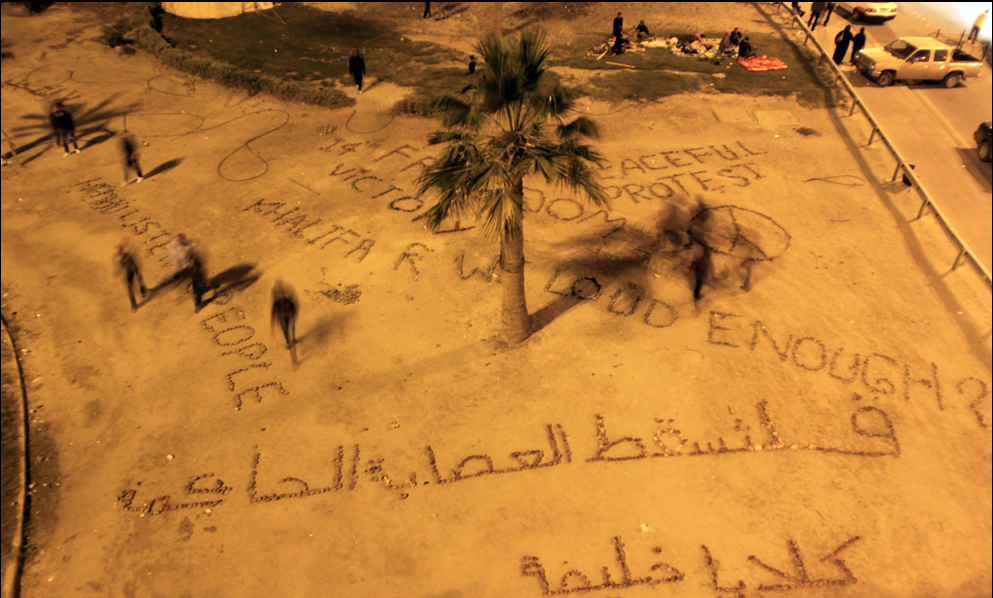
In Bahrain, demonstrators used rocks to spell out messages in the city of Manama. The Arabic message at the center reads, "Down with the gangster government." Photo by Hasan Jamali/AP
3. Winter
Will it ever end? Before it does, let's consider how much fun it can be. Here's another shot from above: Students in Tokyo playing in the snow on February 15. Photo by Kyodo/Reuters
4. Uganda
New York Times photographer Todd Heisler covered the recent elections in Uganda, and told the story by shooting posters plastered on walls across the country. Everywhere, it seemed, was the face of President Yoweri Museveni, who ended up winning another term with two-thirds of the vote.
Monday, February 21, 2011
Iconic Monday: The Engagement of Charles and Diana, told in Three Pictures
At this point it seems a fairly safe assumption the one of the big news stories of the summer will be the royal wedding of Prince William and Kate Middleton. But I tend to look back instead of ahead, which is a curse, but there you go. Thirty years ago this week--Thursday, to be exact--Buckingham Palace announced the engagement of William's parents, Charles, the prince of Wales, and Diana Spencer.
The event, at least for me, can be summed up in three pictures. Two of them are iconic, and they tell a tale of two dresses, of a fairy-tale before and after, though in this case the after was really the middle of a longer story that didn't end happily at all.
Above is the picture that helped catapult Diana to the top of the world-wide celebrity list. I am quite sure that millions of men who really couldn't have cared less about royals or royal wedding suddenly began taking an interest as soon as they saw it. It was taken in the fall of 1980 by one of those enterprising Brit press photographers after rumors began to swirl about Diana and Charles. Diana was working at the time at a nursery school, and, as I recall (from the TV biopic about Diana that I saw many years ago), the pack of photographers staking out the place were delighted to see her walking toward them with the sun at her back. Were these legs going to be royal legs? Ultimately, they were less important in the long run, I think, than the expression, which seems to have been a native instinct of Diana's: head tilted down, eyes looking up. Shy Di, they called her. But the mouth promised something more.
Then she left her flat and roommates and moved into Buckingham Palace and began being tutored on how to be a princess. If I'm not mistaken, the Queen Mother took on the role of teacher. The photo below was taken on February 24, 1981, the day of the official announcement of the engagement.
Let's look at it for one second. It is not iconic, but a historical document. It's one of those family photos that are taken to mark significant moments, and those kinds of photos often end up looking like this. Note the expressions, the body language. the Queen's shoes. Here the promise seems to be of a much colder future.
The other photo I remember from the period was taken during the couple's first public appearance after the announcement. The event was a Royal Opera benefit, and the big news was the dress that Charles's fiance wore. "Lady Di Takes the Plunge," said the Daily Mirror the following day. It was a black taffeta evening gown, strapless and low cut.
It's very wrong to draw too many conclusions from a single still photo, but let's do it anyway. Diana looks happy here--check that, she is glittering. The very picture of a 1980s princess. If there were any doubt, this picture showed once and for all that she was one of those special people who charm the camera. Charles was not blessed with abundant charisma. But he was the future king, and always had been, and I expect he was used to being the main attraction in situations like this. Now there was something new in his life. What do you think he was thinking here?
Subscribe to:
Posts (Atom)