Wednesday, November 10, 2010

The Ansel Saga: Another Contender

One of the Norsigian images
 The story of those "lost" glass-plate negatives supposedly made by Ansel Adams in the 1920s has a new plot development. The plates, discovered by  school painter Rick Norsigian at a garage sale, were valued by a Beverly Hills art dealer with a dubious background at $200 million. But the Ansel Adams Publishing Trust said they were not made by Adams. Then a nice old lady said her uncle, Earl Brooks, had taken the pictures. Today the New York Times reports that another lady has come forward, claiming the negatives were made by her grandfather.

The woman, Melinda Pillsbury-Foster, says the Norsigian images look a lot like images made by Arthur C. Pillsbury, a noted photographer of the period. The good this about this story is that I'm learning about some notable people I've never heard of.


It also seems that the Brooks claim has had a boost in recent days: Uncle Earl's grandson released Brooks's 600-plus page memoir and some old photo albums, one of which has an image "that matches," as the Times put it, an image that Norsigian claimed as an Adams.

I would say this: If you know that one of our great uncles, grandfathers, or sundry relatives visited Yosemite in the 1920s, and carried a camera, it wouldn't hurt to try to find their pictures. Maybe you're sitting on a fortune. Or maybe not.

Tuesday, November 9, 2010

New York Marathon Time Lapse

Today, a break from the still photo. Instead, here's a time-lapse video of Sunday's New York Marathon, released by the Metropolitan Transportation Authority. (Hey, the New Haven Line trains are wrecks, but at least we get cool imagery like this.) My favorite part is the tiny helicopter flittering around like a gnat in the first sequence. My least favorite part is the music, which reminds me of the music in all the "educational" films I saw in elementary school.

Monday, November 8, 2010

Adding Details to the Scope of Darcy Padilla's Epic Documentary Project

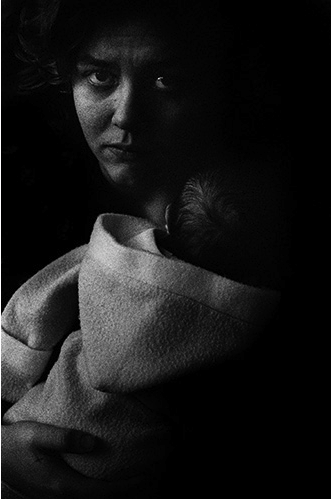
Julie Baird and infant, 1993, by Darcy Padilla
 Last week I put up a post on the blog I write for the Huffington Post about Darcy Padilla, the San Francisco-based photographer who recently was awarded the 2010 W. Eugene Smith Grant for Humanistic Photography. Padilla received the $30,000 grant to continue work on a project that has already taken up 18 years of the photographer's life. In 1993, Padilla began documenting the life of Julie Baird, a 19-year-old woman she met while following a team of social workers and doctors through an S.R.O. hotel in San Francisco's Tenderloin district. Julie, who'd recently been diagnosed with AIDS, was holding her eight-day-old infant. The child's father, Jack, also had AIDS. Nearly two decades later, Baird lay dying in Alaska, under hospice care, and Padilla was there. She was there on September 27, when Baird died.

In my Huffington Post piece I asked what I considered the most obvious question: What made her want to spend a significant portion of her own life telling the story of Julie Baird's life? I got some of the answers I anticipated, and much more.

Friday, November 5, 2010

Photo of the Day: Comet Hartley 2


That comet fly-by mentioned yesterday went very well indeed, at least from the perspective of someone who likes to look at pictures of objects in space—outer space, that is. NASA's probe got some awesome closeups of Comet Hartley 2—and I can say that comets are weirder looking than I imagined. Who did the lighting? ILM?

Thursday, November 4, 2010

State of the Art Portraits...Today's Comet Closeup...Brit Photo Controversy...Astonishing Goats

1. The Art of Portraiture

Art dealer and Philadelphia Flyers fan Peter Hay Halpert has launched a program for showcasing the state of the art in figurative/portrait photography. It's called Identity Now, and the idea is to gather imagery from a diverse cross-section of photographers around the world--artists, commercial photographers, photojournalists...all those traditional genres that often don't mean much in today's world. Any photographer can enter; submitted work will be viewed by a selection committee made up of editors, designers, and artists from throughout the photography world, and the best work—judged "solely on photographic merit"—will be published in a book available online and in bookstores. Now, I should note that I'm part of the selection committee, but I'm in great company, as you can see, and I'm really excited about this. This is an area of photography that I am fascinated by, and I'm looking forward to seeing a lot of work. Pass on the word.

2. Closeup of a Deadly Come


As I write this, a NASA probe known as Deep Impact is about an hour away from getting up close and personal with Comet Hartley 2, which is green looking because it is spewing deadly cyanide gas. (It's not going to hit us, so you can go ahead and prepare your submission for Identity Now). The probe is scheduled to fly through the comet's cloud of nasty gas at 10 AM EDT—it's going to pass within 427 miles of the comet itself, and, best for all of us who like to watch, it's equipped with a couple of imagers, one of which sees in visible light. The image of Comet Hartley 2 above was taken by the Hubble Space Telescope in September. More info here.

3.Brit Photog Under Fire


Famed photojournalist David Hume Kennerly, who was President Gerald Ford's official White House photographer, put out word on Facebook yesterday that he'd been interviewed by a British newspaper about an unfolding controversy...It seems that  the personal photographer of Prime Minister David Cameron, who has been slashing public spending, is on the public payroll. The flap sounds silly to me—the photographer, Andrew Parsons, who was a former Conservative Party employee, probably isn't a budget buster. And, as Kennerly points out, official photographers document history, so the case can be made that they have a legitimate role to play. But it certainly opened up Cameron, who has called for Brits to make "hard choices," to criticism from political foes. Labor leader Ed Miliband rather deliciously mocked Cameron in Parliament: "There's good news for the Prime Minister—apparently [Parsons] does a nice line in airbrushing."

4. Photo of the Week, So Far

Cingino Dam, by Adriano Migliorati/Caters News
 Finally, my favorite picture of the week so far comes from hiker Adriano Migliorati, who shot the 160-feet-high Cingino Dam in Italy last summer. Those dark spots on the dam above are in fact Alpine ibex—mountain goats—doing what they do best, which is scaling vertical rock surfaces. Here's the story. Below is a closeup:

Wednesday, November 3, 2010

Photography Auctions and Angry Voters

Auction Hero: Robert Frank's "U.S. 90 En Route to Del Rio, Texas"
 One of the resources I use to collect info is a publication called The Photo Review. It has exhibition reviews, book reviews, and portfolios that in the past have featured a number of young artists who've become very big artists. I bring all this up for two reasons, only one of which has anything to do with the mid-term elections. (Read on to see how I deftly link congressional upheaval to photography.)

1. My first reason for mentioning The Photo Review is that it holds an annual benefit auction to raise operating funds—it's a non-profit, like this blog—and this year's auction will be held on Saturday (that's November 6) at the University of the Arts in Philadelphia. (You can also bid online; go here for information.) There's good work from old-timers including Edouard Baldus, Edward Curtis, Man Ray, George Seely, and Weegee, and contemporary work from Marilyn Bridges, Larry Fink, Henry Horenstein, and Joel-Peter Witkin, to name a few. If you've got some money to spend, you might be able to pick up something great at a bargain. Which brings me to my second point, which is actually a question:

2. Who's got money for photography? The art market for photography exploded over the past two decades; if you'd bought the right work in 1990, your investment would have outperformed the stock market, including the dot-com and housing bubbles. How's it been doing recently? I decided to ask Steven Perloff, who edits The Photo Review and writes a newsletter for collectors. (Appropriately, it's called The Photography Collector.) Steven keeps a box score of the photo market and an eye on the national economy, because when the stock market is up, wealthy people buy art. (Very wealthy people buy contemporary art, which includes work by Richard Prince and the like.) When it goes down, the rich scrape by in other ways. So the photo market isn't a bad indicator of the mind-set of Wall Street, if not Main Street. And what is that mood? "Umm...it could be worse," said Perloff. But it could be better. Now, about the elections...

Tuesday, November 2, 2010

Lucky Seven Reasons to Love Albert Watson

Road to Nowhere
Photographers who reach a certain level of creative renown, or success, get to be called by their first names only, at least among photo editors. There's Bruce. There was Herb. There is Annie. And there is Albert.

I think I met Albert Watson for the first time in 1988, when I went to see a new studio he had just opened in the Meat Packing District, which at the time was still filled with meat packers (during the day) and tranny hookers (at night). Why on earth, I thought, would he want to be here? The answer was apparent when I saw the studio, which was high-tech, chic, and homey all at the same time--one of the nicest places I'd ever seen. Over the years I payed many visits. Watson established himself as one of the world's elite photographers, and what I found most interesting about him is that he could and did shoot every conceivable kind of subject, in every conceivable style, yet the result was always an Albert picture: dramatic, sexy, sleek, iconic. Watson's knowledge of and use of studio light is unparalleled.

 A few years after Watson opened his studio, the Industria studio opened down the street, and today the area is all boutiques and hotels full of people from London and L.A. Watson himself left a few years ago. He said he didn't need the space anymore because there were so many great rental studios, but maybe it was also because since 2000 or so he's been spending lots of time in Las Vegas, compiling a body of work that is constantly surprising, intimate yet fully observed. There's a show at the Hasted/Kraeutler Gallery with a few of the images, along with other Watson work, and tonight he'll be making a presentation, along with famed photography editor Laurie Kratochvil, at the Helen Mills Theater, 137 W. 26th Street in New York. Doors open at 6:30, and the talk at 7:00. (The presentation is sponsored by the Society of Publication Directors, and you can find more information at its website.)

In the meantime, I've put together seven lucky reasons to love Albert's Las Vegas work.

Breaunna, Las Vegas Hilton
The God Sign, Rt. 15
Dogs in Car
Stripper Shoe
Sink at the Oasis
Heat Lightning