Monday, May 16, 2011

Iconic Monday: The Art of the Perp Walk

Strauss-Kahn and police escort. Photo by Joe Marino/New York Daily News
The people of France woke up yesterday morning to the news the Dominque Strauss-Kahn, considered a leading contender to the be the nation's next president, had been arrested in New York City on charges of attempted rape. This morning, the French, who love tradition and ritual as much as anyone, were treated to one of the NYPD's most beloved ceremonies: The Perp Walk, a.k.a. "The Walk of Shame."

As a piece of theater, the Perp Walk is both drama and farce. The display of the recently arrested for the benefit of news photographers may be staged, but the tragedy inherent in the event is real. The Perp Walk is when reality and television police procedural become one in the same. Defense attorneys have complained that the Perp Walk photo is prejudicial, but so far at least the need for visual narrative has taken precedence over absolute legal fairness.

The narrative is especially satisfying when the person in handcuffs is famous or powerful in some regard. It's human nature to want to see the high and/or mighty brought low—from WikiLeaks mastermind Julian Assange, arrested in the UK for earlier sex charges, to former congressman Tom "The Hammer" Delay, caught up campaign finance shenanigans.

Julian Assange after arrest. AP PHOTO

Tom Delay (center) walks the walk
 High-flying businesspeople are among the most visually delectable Perp Walk subjects, a fact prosecutors are exceedingly well aware of. As the Wall Street Journal pointed out in this Perp Walk portfolio, the spectacle sends a clear message that no one is above the law.

Former Bear Stearns fund managers being escorted to jail in 2008. REUTERS PHOTO
The Perp Walk is, of course, only Act I the legal drama that ends with a trial and verdict. But each of these later acts comes with its own visual rituals, such as the arrival at the courthouse of the defendant. An example:

Lohan strolls the stroll
In this photograph, Lindsay Lohan arrives at a Los Angeles court last February 9 in a tight, white thigh-high dress that prompted New York Times fashion journalist Ruth La Furla to wonder whether the actress was turning the Walk of Shame into an "image boosting stroll of fame."

Of course the most infamous Perp Walk photo was taken on Sunday, November 24, in the basement of the Dallas Police Headquarters.


Lee Harvey Oswald was supposed to be transferred from the police building to the county jail that morning, with journalists on hand to watch. Also on hand was nightclub operator Jack Ruby, who, at 11:21 AM, turned this walk of shame into something truly shameful.

Friday, May 13, 2011

Week In Photos: Osama’s tourist attraction…topless congressmen…and more

My weekly review of photography from the US press is up at Le Lettre de la Photographie. The samples:

1. After Abbottabad


The week following the successful operation against Osama bin Laden, President Obama’s approval rating in one poll climbed dramatically. Last month, 46 percent of Americans said they approved on his overall job performance; this week, 57 percent gave him thumbs up. In Abbottabad, Pakistan, the compound in which Bin Laden lived, and died, became a tourist attraction. Here, a woman photographs her daughter at the cmpound’s gate. Photo by Aqeel Ahmed/AP.

2. A Face in the Crowd


The scene here has become the great visual cliché of the Arab Spring uprisings—angry demonstrators in crowded streets, fierce faces and fists raised for photojournalists’ lenses. The dynamism and expression of this Yemeni boy, photographed during a demonstration in Sana, makes Hani Mohammed’s picture a standout. Photo by Hani Mohammed/AP

3. War Photographers


The deaths of photojournalists Tim Hetherington and Chris Hondros in Misrata, Libya in April focused attention of the dangers that war photographers face. Christopher Anderson, a veteran combat photographer himself, made portraits of a number of his colleagues, who appear as apparitions in a half-world away from guns and bombs. From left: Yuri Kozyrev; Tyler Hicks; Michael Kamber; Lynsey Addario, Ashley Gilbertson; and Alan Chin.

4. A Day at the Races


The Kentucky Derby comes with abundant tradition, like mint juleps and very strange hats. The event’s most honored visual tradition is the shot of horses racing toward the finish line, shot from inside the rail with the landmark spires of the Churchill Downs in the background. The addition of looming grandstands on either side of the older building has spoiled the gracefulness of the view, but John Gress of Sports Illustrated captured the excitement of the moment as this year’s winner, Animal Kingdom, thundered past, leading the pack by two-and-a-half lengths.

5. Body Politic

One of the more controversial images of the week appeared on the cover of Men’s Health magazine. It shows Illinois Congressman Aaron Schock shockingly exposed in an unbuttoned shirt. The magazine dubbed Schock, who is a Republican, as “America’s Fittest Congressman,” which is  not as lofty a political pedigree as that of Massachusetts Senator Scott Brown, another Republican, who was once named “America’s Sexiest Man” by Cosmopolitan magazine, in which he posed nude. It is a better fate, however, than that of former Republican Congressman Chris Lee, who resigned after sending a topless picture of himself to a woman he met on Craigslist. America’s right wing is pumped. The cover was shot by photographer Martin Schoeller.


Monday, May 9, 2011

Visual Update Monday: The Situation Room...Colossal 3D Wee Wee Book

 The fallout over the picture of senior Obama administration figures in the White House Situation Room won't stop reverberating through the visual culture. As noted earlier, the image, taken by White House photographer Pete Souza as Navy Seals killed Osama bin Laden, has won wide praise as historical document. Secretary of State Hillary Clinton spoiled some of the fun when she told reporters that her hand-over-mouth look of concern was in fact merely a stifled cough, which rankled MSNBC's Chris Matthews, who either didn't believe Clinton's explanation or simply preferred his own. "My guess—and my God—what's wrong with having a decent reaction to a horrific picture?" he said.

 
Meanwhile, an Ultra-Orthodox Hasidic Jewish newspaper apparently disapproved of Clinton's presence in the Situation Room so much that it removed her from the image. Der Tzitung also removed Director for Counterterrorism Audrey Tomason because of its policy not to publish pictures of women that might be sexually suggesting. Or, according to the Daily Mail, pictures of women in positions of power.

I also need to update an earlier post regarding a new 3D version of The Book of Big Breasts. With only some small degree of jest I noted that I was thankful the publisher, Taschen books, wasn't also bringing out a 3D version of another title, The Big Penis Book. Of course that's just what Taschen has done: On May 11 there will be a big party at the Taschen store in Beverly Hills for the lunch of The Big Penis Book 3D.


The company says reaction to the new title so far has been "pointedly enthusiastic." Indeed, this is why we even need a third dimension. 

Friday, May 6, 2011

The Week In Photos: Obama Gets Osama

My full photo review at Le Lettre de la Photographie is up...here is the weekly sample:

1. Situation Room


The most talked-about photo of the past week—the week in which, after nearly ten years, the United States caught up with Osama bin Laden—was a picture we haven't seen: President Obama says he will not release an image of the late terrorist's corpse. The second most talked-about image? This one, taken by White House photographer Pete Souza in the basement of the White House on Sunday, as the president and his senior staff gathered in the Situation Room to keep a real-time vigil as Navy Seals attacked Bin Laden's compound.

As a document of a historic moment, the picture has already achieved iconic status. Only days after it was published, a panel of photo editors was asked to describe what in particular made the image so compelling, and most mentioned the expression of Secretary of State Hillary Clinton—"clearly, she's reacting to something she's seeing," said one of the editors. In fact, Clinton herself said later, she may have been only trying to stifle a cough brought on by seasonal allergy. For me, the most interesting aspect of the image is its description of the Obama leadership style: He sits in a corner, letting others take pride of place at table, confident, we can assume, in his command authority. It is obviously dangerous, however, to make too many assumptions about what a photograph does or does not show.

2. Celebration


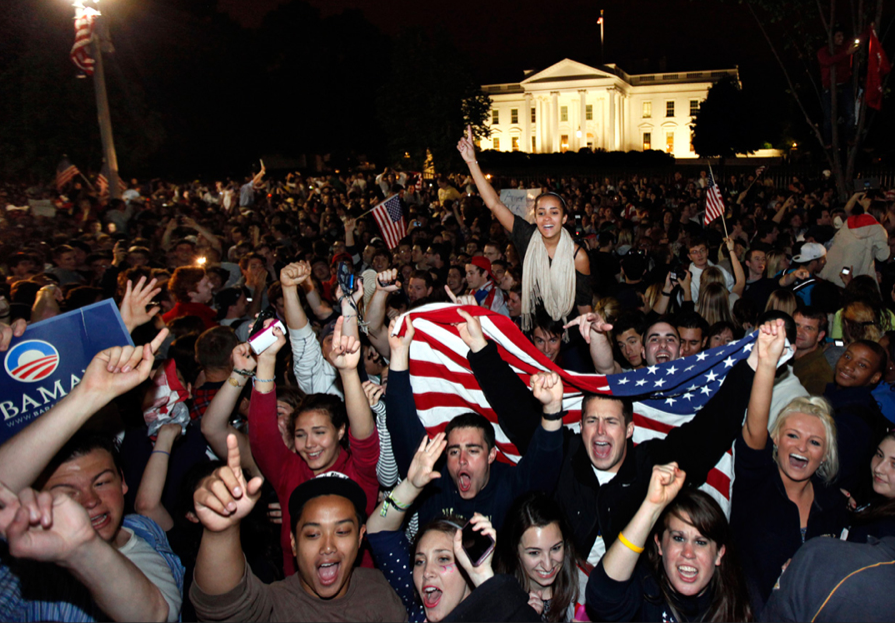
One of the remarkable sights on Sunday night, as word began to spread of Bin Laden's death, was the crowd that grew from minute to minute in front of the White House. The people there were young, perhaps arriving from nearby George Washington University, rejoicing at the demise of a haunting figure of terror from their childhood. The celebration was captured here by Manuel Balce Ceneta/AP.

3. Closure


The images of celebration in Washington and New York in the wake of the Bin Laden news provided a visual closure to the scenes of destruction and death the world witnessed on 9/11. Michael Appleton of the New York Times photographed members of the New York Fire Department's Ladder Company 4, "The Pride of Midtown," as they sat on a truck parked in Times Square. Appleton was only 23 and just beginning his photography career when he photographed the collapse of the World Trade Center's twin towers.

4. Remembrance


Celebration and remembrance, vastly different in spirit, went hand in hand. Finbarr O'Reilly of Reuters captured the latter with this image of flag wavers, their shadows cast against a wall at Ground Zero in New York.

Thursday, May 5, 2011

Bin Laden: Should We See the Photo?

That seems to be the question of the day. Should President Obama release a photograph of Osama bin Laden's body? The president himself says he won't, likening such as act to spiking a football after scoring a touchdown.

"It is important to make sure that very graphic photos of somebody who was shot in the head are not floating around as an incitement to additional violence or as a propaganda tool," the president said.

Thus, according to the president, the risk of being penalized for excessive celebration outweighs the need for visual documentation of Bin Laden's death. Do you agree, or disagree? Either choice requires you to assume that a photograph would provide satisfying evidence of Bin Laden's death, and frankly I don't think that's an assumption that can be made in this day and age.

Wednesday, May 4, 2011

Iconic Wednesday: Marilyn Wears Chanel N°5


Ninety years ago this week, the world started smelling much, much better: On May 5, 1921, Parisian couturier Gabrielle “Coco” Chanel launched her first perfume, Chanel N°5. You might say it was one of the modern world’s greatest achievements of olfactory design, and of course you would be correct. (The New York Times’s Chandler Burr heroically described the scent as being “like a bank of hot searchlights washing the powdered stars at a movie premiere in Cannes on a dry summer night.”) But the cultural status of Chanel N°5 rests on more than just one of our five senses. Ironically, a product meant to delight the nose owes a great deal of its success to a medium meant for the eyes.

Monday, May 2, 2011

In Print: May 2, 2011

Somewhere in my home is the copy of the New York Times that was delivered on September 12, 2001. You do things like that on days like those--you know to put the newspaper away. Why? We don't need old newspapers to remember an event like 9/11. Instead, they are souvenirs that attest to the fact that we existed when those events happen: The newspaper, an object, says that in some way we were part of that event. That's one of  journalism's roles, I think--to turn history into stories, into which we can insert our own lives. Pictures are key to that, because they turn us all into eyewitnesses.

 I will of course be saving today's copy of the Times--I'll try to find the one from ten years ago and keep them together in the same place, bookends to a narrative.


 When the daily newspaper isn't there anymore--in print, that is--what will we do on days like this? What will we have to put away somewhere? Perhaps we will turn to artists, rather than journalists, to get the touchstones of history we need. In fact, I think that process began some time ago, but for now at least we still have our newspaper front pages, and I'm glad of it. Of course with the internet we can see as many newspaper front pages as we like. But there are some you just want to put your hands on, to to raise above your head and wave, like this one: